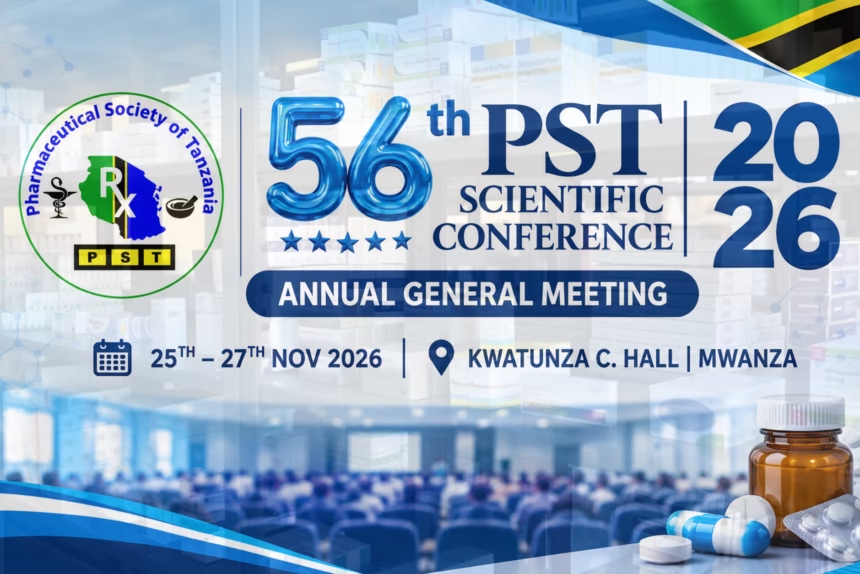
In three weeks, pharmacists, pharmaceutical technicians, regulators, researchers and students will gather on the shores of Lake Victoria for the 56th Annual General Meeting (AGM) and Scientific Conference of the Pharmaceutical Society of Tanzania (PST). The event runs from 25 to 27 November 2026 at Kwatunza Beach Conference Hall in Mwanza, and it combines scientific sessions, an exhibition and the society’s governance business, including an election for its Executive Committee.
PST describes the gathering as the premier pharmaceutical event in East Africa. Whether or not that claim holds, the programme suggests a meeting with a clear argument to make about leadership.
A theme about handing over
The 2026 theme is “Generational Change: Unlocking Pharmacists’ Potential to Lead Tanzania’s Health and Pharmaceutical Manufacturing Transformation.” PST has not published a statement explaining the wording, so any reading is interpretation. Read plainly, though, the theme ties two things together: a younger cohort of pharmacists moving into senior roles, and a health sector in which medicines manufacturing and financing are changing.
That pairing makes sense against the profession’s numbers. PST’s website lists 15,226 registered pharmacists on the Pharmacy Council register and eight zones through which the society organises its members. With that many registered practitioners across the country, the conference is one of the few places where members from different zones and sectors meet in one room.
What is on the programme
PST has named three plenary sessions: pharmaceutical manufacturing and local production, universal health coverage and health insurance, and supply chain resilience and access to medicines. Each touches a practical pressure point. Local production affects which medicines can be made close to patients. Health insurance changes how pharmacies are paid and what patients can claim. Supply chain failures decide whether a prescription can be filled at all.
Alongside the plenaries sit three scientific tracks:
- Digital health and innovation in pharmacy
- Hospital and clinical pharmacy
- Prevention, health promotion and immunisation
The clinical pharmacy track will interest hospital-based readers in particular. A 2023 qualitative study in five tertiary hospitals, published in BMC Primary Care, found that pharmacists’ integration into clinical services was held back by staff shortages, a lack of in-job training and a lack of standard operating procedures and guidelines. The same study noted that other health professionals accepted clinical pharmacy services well. Sessions that deal with those gaps would be useful, although PST has not yet published session-level detail.
The call for abstracts ran from 1 June to 15 October 2026 and has now closed, so the final scientific programme should follow once submissions are reviewed. PST has also listed zone meetings, sessions on youth empowerment and workforce development, and engagement with regional and international leaders.
The election on the final day
The AGM itself takes place on 27 November. In an official notice dated 13 October 2026, the PST Secretariat announced that posts on the Executive Committee are open for election at the meeting, citing section 7.2.4 of the society’s constitution and Chapter 2 of its by-laws. Members who want to stand are directed to the society’s polling page. The positions and the timetable for applications are set out in the notice itself, so members should check it directly rather than rely on a summary.
For ordinary members, this is the practical meaning of the theme. The people elected in Mwanza will guide the society’s engagement with regulators, employers and the public during the next term.
Practicalities for those attending
The conference carries 25 continuing professional development (CPD) points, which matters to registered pharmacists who must meet CPD requirements for licensure. Registration fees on PST’s site range from TZS 100,000 to TZS 270,000 for local participants, with USD 150 listed for others from Tanzania and East Africa and USD 200 for international delegates. The site does not break the local range down by category in the information published so far, so check the registration page for the rate that applies to you.
Registration covers conference materials, refreshments for the three days, a certificate of participation and access to all exhibition areas. PST says the audience includes pharmacists, pharmaceutical technicians, regulatory professionals, researchers, students and industry leaders. Registration is through the society’s events page, and the secretariat can be reached at [email protected] or +255 761 499 490.
A meeting with a track record
PST’s annual conference has drawn sizeable crowds before. The 52nd conference, held in Dodoma, attracted about 700 participants, according to Daily News coverage, and the society’s president at the time used it to press for stronger professional standards and clearer disciplinary powers. PST’s site also lists a June 2025 conference at the Arusha International Conference Centre. Whether Mwanza draws a comparable turnout is something only the opening day will show.
Anyone planning to attend should register early, check their CPD status and read the election notice before they travel.